The Pariah Porcupine
I have a feeling I am being repetitive, but the ceiling fan in my study wobbles. It has wobbled for three years. I have not fixed it. This morning, at quarter past six, I watched it describe its irregular ellipse while drinking tea that had gone lukewarm, and I thought: this is the correct metaphor. Not the grand metaphor. Not the fan as symbol of a nation in centrifugal decay. Just the fact of a wobbling fan that I have learned to live with, that I notice every morning and do nothing about, that will one day detach and concuss me or my cat or simply die with a spark and a smell of burning insulation, and on that day I will be surprised, though I have no right to be.
Calcutta is humid today. The monsoon has been tardy, theatrical, withholding. The IMD says heavy rain is likely in the north, no cyclone threat. The newspapers say three men died in a warehouse collapse. The chief minister has halted all construction in the city, which means nothing will halt, because halting construction in Calcutta is like asking the Hooghly to pause. The river does not pause. The city does not pause. It accumulates. Layer upon layer of ordinance and violation, permit and bribe, ambition and resignation, until the accumulated weight produces a warehouse collapse or a bridge crack or a hospital ceiling that surrenders to gravity at 3 a.m. during a dengue outbreak.
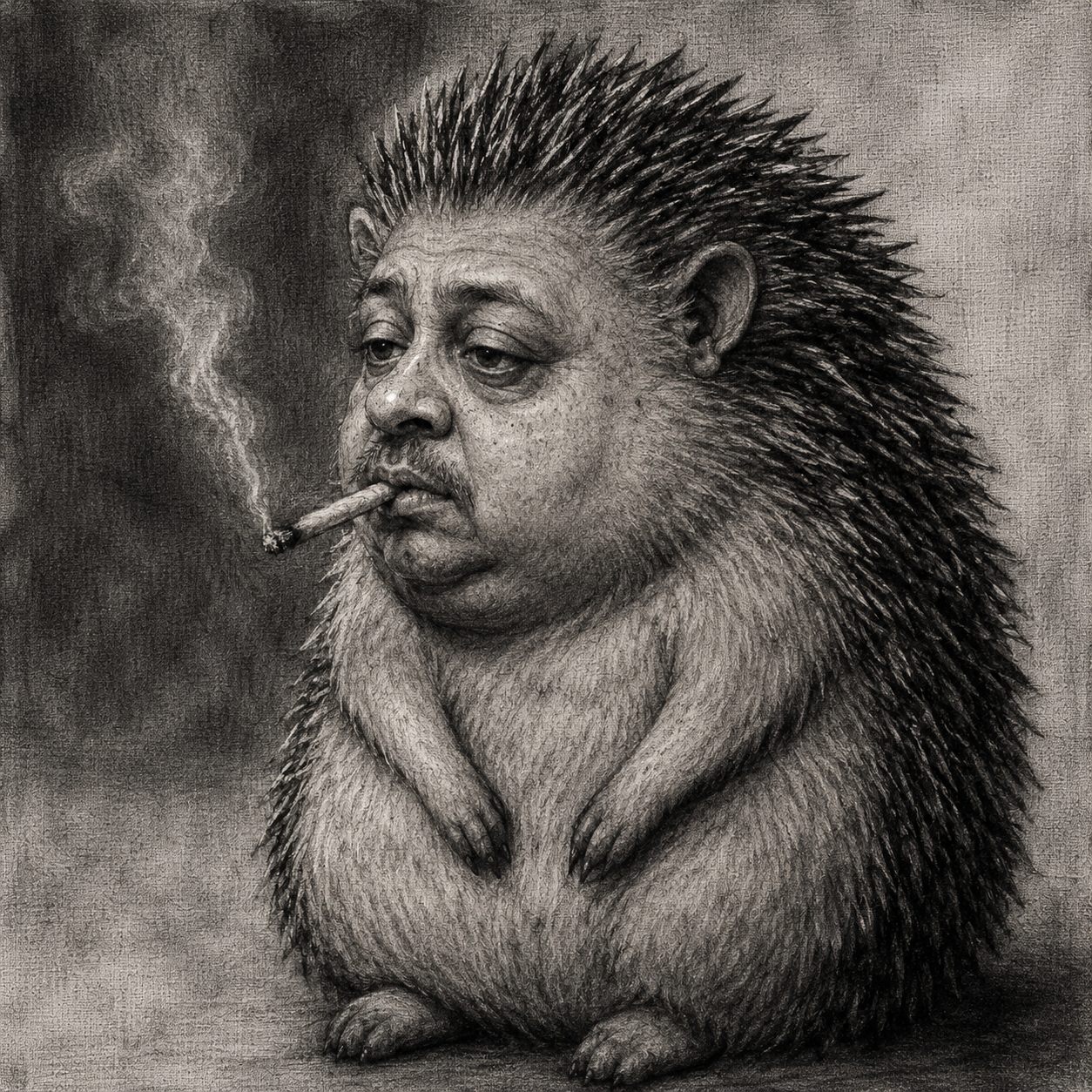
I am not a doctor. I am an engineer. And I am a man who reads too much and speaks too directly at dinner parties, which is to say I am a man who receives fewer dinner invitations than he once did. The pariah porcupine, if you like. The metaphor is inelegant. A porcupine is not a social animal to begin with, so its pariah status is redundant. But the quills are the point. You raise a subject that is not raised—public healthcare, for instance, not as a lament but as a structural observation, not as sentiment but as engineering—and people flinch. They flinch because the quills are real. The discomfort is real. You have introduced a category error into a conversation that was proceeding smoothly through mythology and cricket scores and the price of mustard oil.
I do not blame them entirely. There is a fatigue to living here that is difficult to explain to someone who has not experienced it. It is not the fatigue of poverty, though that exists and is crushing. It is the fatigue of maintenance. Of watching things that were built with some intention slowly surrender to entropy, and of understanding that the entropy is not accidental. It is chosen. It is elected. It is the aggregate of ten thousand small decisions to not maintain, to not regulate, to not inspect, to not care, because caring is expensive and inconvenient and politically unrewarding and, most of all, because the people who would benefit from the caring are not the people who make the decisions.
The public hospital in my neighborhood has a sign that says “Emergency” in peeling paint. The emergency room has one functioning ventilator, last I heard, and the air conditioning unit in the pediatric ward caught fire two months ago. No one was injured, which is the standard by which we measure success. No one was injured. The ceiling did not fall on a patient’s head. The fire was extinguished before it spread. Success. The bar is so low it is underground, tunneling toward the water table.
I have a friend, a physician, who works in a private hospital in Salt Lake. He is competent and conscientious and exhausted. He tells me that the private hospitals are not the solution. They are the pressure valve. They allow the affluent to pretend the system functions because their own experience of it—air-conditioned rooms, nurses with verified credentials, equipment that beeps correctly—is functional. The private hospital is a bubble of competence in a sea of institutional failure, and the bubble reinforces the delusion that competence is available to anyone who deserves it, who works hard enough, who is meritorious. The NEET exams, which are in the news again because of paper leaks and protests and water cannons in Rajasthan, are supposed to filter for merit. But merit, in this architecture, is simply the ability to navigate a system that leaks at every joint. The students who protest are not wrong. The minister who denied the leaks before admitting them was not lying, exactly. He was performing the standard script of institutional delay: deny, then investigate, then form a committee, then wait for the news cycle to turn, which it always does. Tomorrow there will be a yoga day event, or a naval induction, or a renaming of an avenue, and the NEET students will still be waiting.
I am not cynical. I want to be clear about that. Cynicism is a luxury. It is the posture of someone who has given up and wants credit for the wisdom of their surrender. I have not given up. I am simply no longer surprised. There is a difference. The surprised person expects the system to work and is wounded when it does not. I expect it to wobble, like my ceiling fan, and I am wounded only when the wobble produces an actual concussion. This is not cynicism. This is the arithmetic of accumulated experience.
The question that occupies me, on humid mornings with lukewarm tea, is why the apathy is generational. Why does it pass from father to son, from government to government, as reliably as the monsoon? I have a theory, which is only a theory, and probably wrong, but it is the one I have. The theory is that civic infrastructure is invisible in the way that grammar is invisible. You notice it only when it fails. A functioning sewage system does not produce stories. A bridge that does not collapse is not news. The newspaper does not run a headline: “Bridge Stands Another Day.” The political reward for maintenance is zero. The political reward for a new project—a new airport, a new statue, a new scheme with a Sanskrit name—is immediate and photographic. So the system optimizes for the visible and the new, and the invisible and the old rot quietly, until they rot loudly, and then there is a tragedy, and then there is an inquiry, and then there is a new project to replace the old one, and the cycle repeats.
I think of this when I walk past the public health center near my house. It is a small building, built in the 1970s, with a courtyard where people wait on benches that are bolted to the concrete. The benches are occupied from dawn. The people waiting are not impatient in the way of people waiting for a delayed train. They are patient in the way of people who have learned that impatience is expensive and futile. They sit. They wait. The doctor arrives at ten, or eleven, or not at all. The medicines, when available, are generic and sometimes expired. The people take what they are given. They do not complain, because complaining is a skill that requires education and time and the confidence that someone is listening, and none of those things are available in sufficient supply.
I have spoken about this. At dinner parties, yes, but also in writing, in conversations with officials who nod and make notes and do nothing, in the resigned manner of people who have heard it all before and have their own theories about why nothing changes. Theories about funding, about federalism, about the impossibility of governing a country this size with institutions this young and populations this diverse. The theories are not wrong. They are incomplete. They omit the simplest explanation, which is that the people who could change things do not want to change things, because change is disruptive and the current arrangement, however unjust, is familiar and navigable if you have the right connections and the right bank balance.
The pariah porcupine does not expect to be embraced. He expects to be tolerated, at best, and at worst to be excluded from the dinner party entirely, which has happened, which is fine. I am not lonely. I have my wobbling fan and my lukewarm tea and my morning walks past the health center where people wait on bolted benches for doctors who may not come. I have the small, persistent irritation of seeing things clearly and being unable to look away, which is not a virtue, only a temperament. Some people can look away. I cannot. This is not bravery. This is a kind of visual stutter. The image stays in the frame.
Yesterday I read that the Union Health Minister launched a campaign to stop diarrhea. This is not satire. This is a real thing that happened, on the same day that the death toll in a hooch tragedy rose to fifty-eight in Tamil Nadu, on the same day that students protested paper leaks in the examination that determines who will become a doctor in a country where doctors are scarce and the ones who exist are exhausted. The campaign to stop diarrhea is not wrong. Diarrhea should be stopped. It kills children, still, in 2026, in a country that sends missions to the moon and builds aircraft carriers and renames avenues after men whose first names are confused with other men’s first names. The campaign is simply disproportionate. It is a gesture at the margin of a catastrophe, a bandage on a limb that has already gangrened.
I do not know what to do with this knowledge. That is the honest thing. I am not writing a manifesto. I am not running for office. I am a man in a humid city with a wobbling fan, watching the accumulated weight of generational apathy press down on the public institutions that are supposed to protect the people who wait on bolted benches, and I am saying, to whoever is still listening at this dinner party that I was not invited to, that the ceiling is going to fall. Not today, perhaps. Perhaps not this year. But the wobble does not correct itself. The wobble widens. The wobble is the system announcing its intention to fail, and the only response we seem capable of is to sit beneath it and hope we are not the ones concussed when it finally detaches.
This morning, after the tea went cold, I called a mechanic about the fan. He said he would come Thursday. I do not believe he will come Thursday. I will call again. This is the only honest work I know: to call the mechanic, to write the sentence, to speak at the dinner party even when the invitations dwindle, to refuse the anesthetic of mythology and self-congratulation that allows a nation to celebrate its ancient wisdom while its children die of preventable diseases in buildings where the air conditioning catches fire and no one is injured, which is the standard by which we measure success, which is the standard by which we have agreed, collectively, to fail.
The fan wobbles. I watch it. The monsoon will come, or it will not. The people will wait on the benches. The minister will launch another campaign. The porcupine will keep his quills, not because they are useful, but because they are true.
P.S. References are not genuinely needed. The facts in this essay are common knowledge to anyone living in India in 2026. The warehouse collapse, the NEET protests, the health minister’s campaign, the hooch tragedy, the renaming of Suhrawardy Avenue—these are in the newspapers, which everyone reads and no one believes, which is another kind of wobble, another kind of waiting.